
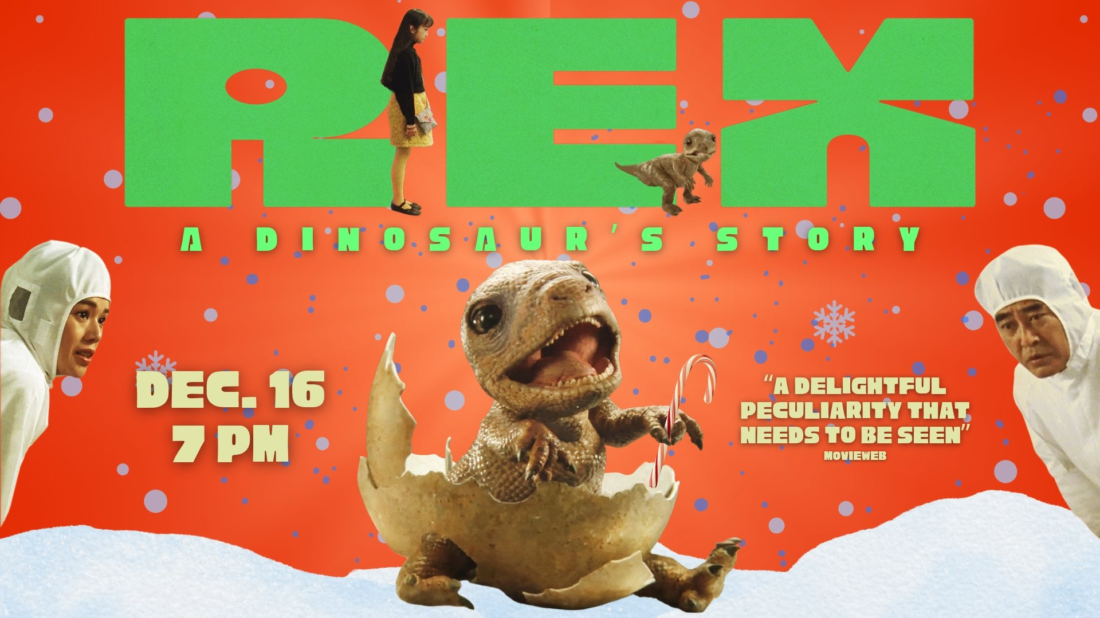

Delirious Japanese Christmas cult obscurity REX: A DINOSAUR’S STORY (1993)
December 16 : 7:00 pm – 9:00 pm
“An interesting oddity in both narrative and delivery… a delightful peculiarity that needs to be seen” – Movieweb
Directed by storied mogul and industry disruptor Haruki Kadokawa, and released two weeks before Jurassic Park, Rex: A Dinosaur’s Story emerges from amber today as an exemplar of a bygone era of Japanese blockbusters. It follows Chie (Yumi Adachi), the young daughter of a paleontologist who soon befriends an adorable T-Rex. As everyone seeks to exploit the dino-discovery for profit, the pair soon find themselves on the run from shady men in black and profiteers forcing Rex to act and model for endless advertisements and merchandise (pointing to the film’s actual promotional campaign, the “media-mix” strategy that spanned toys, a CLAMP manga and songs… even cementing the popularity of Kentucky Fried Chicken as a de facto Christmas tradition in Japan!) Featuring expressive creature effects by Carlo Rambaldi (Alien, E.T., Possession); chase scenes by carriage, snowmobile and hot air balloon; in-camera height jokes and tokusatsu-indebted “suit-mation”, as well as startling Christmas imagery, Rex is as adorable as it is unhinged, functioning as both wholesome Holiday crowd-pleaser and cult curio in the making, available in the West and remastered in high definition for the very first time!
About Haruki Kadokawa
A controversial figure in Japanese cinema, business mogul Haruki Kadokawa inherited his father’s publishing company and promptly set out to position Kadokawa as a media giant looming large on the Japanese pop culture of the 1980s. An exuberant character (who built his own Shinto shrine, relished writing haiku poetry and reportedly sailed to Barcelona on a replica of the Santa Maria, among other PR stunts), he pioneered a new (now commonplace) approach to releasing and marketing films. This was dubbed the “media mix”: the act of positioning films in a wider ecosystem of crossmedia merchandising that includes books, music, and eventually its own industrial system of ready-made stars named “idols”. Taking advantage of the collapsing studio system and Kadokawa’s rich trove of literary IPs, he entered film production with 1976’s The Inugami Family, directed by Kon Ichikawa and based on a novel by Seishi Yokomizo. This was followed by blockbusters Proof of the Man (1977), the first Japanese film shot in New York, and Virus (1980), the most expensive Japanese production of its time – all based on novels. 1981’s Sailor Suit and Machine Gun, directed by Shinji Somai, marked Kadokawa’s shift towards the idol system. Successful collaborations with directors including Nobuhiko Obayashi (The Girl Who Leapt Through Time), Kinji Fukasaku (The Fall Guy), Yasuharu Hasebe (Fossilized Wilderness), Yoshimitsu Morita (Main Theme) and Shinichiro Sawai (W’s Tragedy) also helped diversify the company’s portfolio. Rex: A Dinosaur’s Story, one of Kadokawa’s own directorial efforts, is often described as the apotheosis of the company’s approach to blockbuster filmmaking while simultaneously being read in autobiographical terms that reflect the producer’s own estrangement from his mother. Its release was infamously interrupted when Kadokawa was arrested for cocaine smuggling in 1993, leading him to resign from the company.
Arkadin does not generally provide advisories about subject matter or potentially triggering content in films, as sensitivities vary from person to person. However, we encourage researching titles to determine if a screening may contain content that could be upsetting to you. Please feel free to contact us for guidance on specific films. Information about content can also be found on Common Sense Media, IMDB and DoesTheDogDie.com, as well as through general internet searches.
Theater Policies
- All seats are first-come, first-served.
- The theater opens 30 minutes prior to showtime, except for “Happy Hour” events and pre-shows when the theater opens at the listed start time.
- When a screening is sold out, we open a waitlist 30 minutes before showtime. You must physically come to the lobby to get your name on the waitlist. Seats are released as they become available. All remaining seats are released at showtime.
- All ages are welcome at Arkadin except for Drinkolas Cage events, which are restricted to 21+. We follow the MPAA rating guidelines for all other films.
- Tickets can be purchased using the BUY TICKETS link above. Upon ordering, you will receive a confirmation email from Square. Tickets may also be purchased on the day of the show at the concession counter.
- If you’ve purchased advance tickets, when you arrive, please give your name at the concession counter to check in.
- Tickets are returnable by sending a request through the contact form located on our About Us page prior to showtime.
- When an event is sold out, we reserve the right to release open seats to customers on the waitlist. If you have a pre-purchased ticket and arrive late and there is no seat for you, your ticket will be refunded.
- All screenings are held in our indoor theater unless indicated otherwise in the event description above.
- Please respect your fellow movie-goers by remaining quiet and refraining from using your cell phone throughout the screening.